Cold brew · 8 min read
How to Make Cold Brew Concentrate at Home
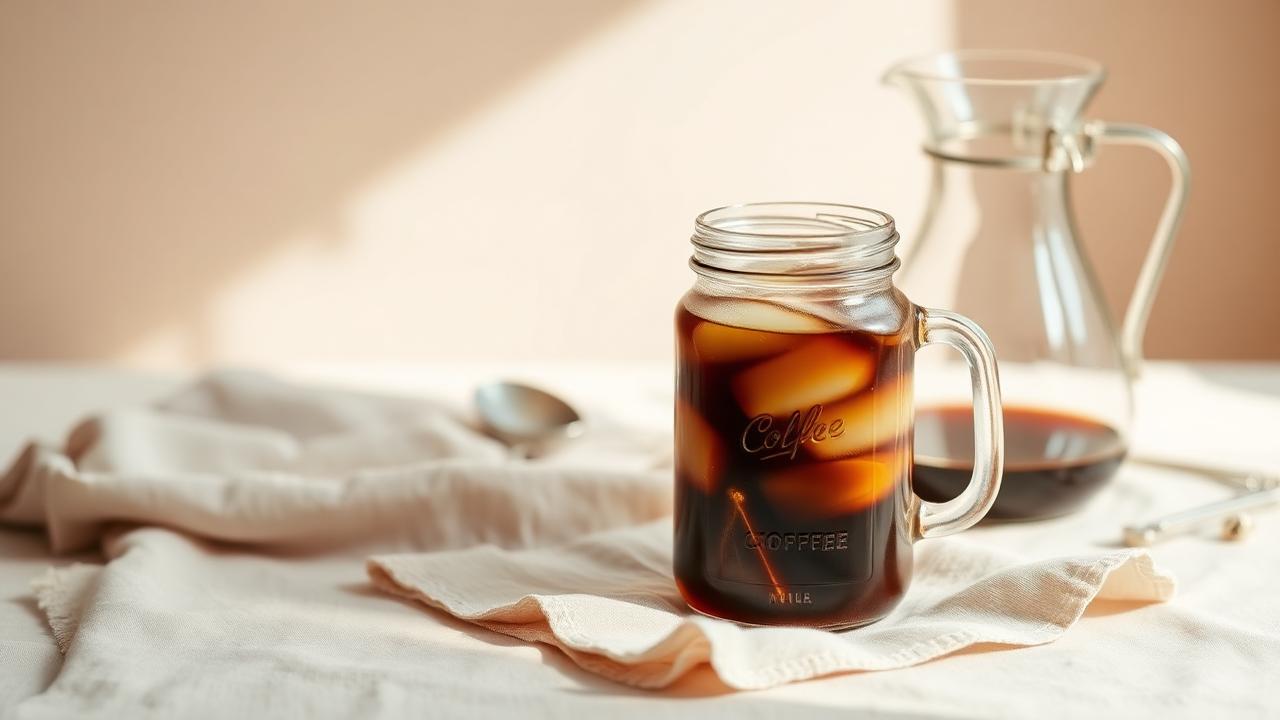
Short answer
To make cold brew concentrate, combine 200 g coarsely ground coffee with 1 litre filtered water, stir until fully saturated, and steep covered in the fridge or at room temperature for 14 to 18 hours. Filter slowly through a fine sieve and paper filter. Dilute the concentrate with equal parts water or milk before serving.
Key takeaways
- Use a 1:5 coffee-to-water ratio for a versatile concentrate.
- Grind coffee coarse, similar to raw sugar or French press grounds.
- Steep for 14 to 18 hours; longer is not always better.
- Filter twice for a cleaner, less gritty concentrate.
- Store refrigerated in a sealed bottle for up to 7 days.
What is cold brew concentrate?
Cold brew concentrate is a strong coffee liquid made by steeping coarse coffee grounds in cool water for many hours. Unlike ready-to-drink cold brew, it is designed to be diluted before serving. A concentrate gives you flexibility: add cold water for a black iced coffee, milk for a smoother drink, or a smaller amount of hot water for a quick warm coffee. Its lower-acid perception and rounded flavour come from slow extraction rather than heat.
The word concentrate matters because the recipe uses less water than a standard cold brew. A common ready-to-drink ratio is around 1:8 to 1:10 coffee to water by weight. For concentrate, 1:5 is a reliable starting point. That means 200 g coffee to 1 litre water. After the grounds retain some liquid, expect roughly 700 to 800 ml of filtered concentrate rather than the full litre.
Cold brew is not simply coffee left to go cold. Hot coffee is extracted rapidly with heat, then cooled. Cold brew extracts gradually at cool temperatures, bringing out chocolate, nut, caramel and mellow fruit notes while generally avoiding much of the sharpness associated with over-extracted hot coffee. The result still depends on the beans, grind, water and steep time.
- 01Standard concentrate ratio: 1 part coffee to 5 parts water by weight
- 02Ready-to-drink starting ratio: 1 part coffee to 8 to 10 parts water
- 03Serving dilution: 1 part concentrate to 1 part water, milk or ice
- 04Expected yield from 200 g coffee plus 1 litre water: about 700 to 800 ml concentrate
Which coffee beans are best for cold brew concentrate?
Choose coffee you enjoy drinking, but favour beans with enough body and sweetness to remain satisfying after dilution. Medium and medium-dark roasts are forgiving choices for first attempts. They commonly produce cocoa, roasted nut, caramel and brown sugar notes that work especially well with milk and ice. A darker roast can taste pleasantly bold, but very dark coffee may bring smoky or bitter flavours after a long steep.
Single-origin coffees can make excellent cold brew, particularly naturally processed coffees with berry or tropical fruit notes. However, their character may become more pronounced as the concentrate sits in the fridge. A balanced espresso or filter blend is often the easiest route to a consistent, crowd-pleasing result. If buying from a specialty roaster, ask for a coffee that is sweet, soluble enough for immersion brewing and not overly delicate.
Freshness matters, though cold brew does not require coffee roasted yesterday. Coffee that is around 7 to 30 days off roast is usually easy to work with. Buy whole beans where possible and grind just before brewing. Pre-ground coffee loses aroma quickly and is often too fine for cold brew, making filtration slow and increasing sediment in the finished drink.
- 01For chocolate and caramel notes: choose a medium or medium-dark roast
- 02For fruit-forward cold brew: try a naturally processed medium roast
- 03For milk drinks: use a sweet, full-bodied blend
- 04Avoid extremely fine pre-ground coffee where possible
What equipment do you need to make cold brew concentrate?
You do not need a dedicated cold brew maker. A large glass jar, jug, food-safe container or French press will work, provided it has enough room to stir coffee and water without spilling. For a 200 g coffee recipe, use a vessel with at least 1.5 litres capacity. Glass is easy to clean and does not retain odours, while stainless steel is durable and blocks light.
A digital scale is the most useful tool because cold brew ratios are based on weight, not spoon measures. Water and coffee vary in density, and a scoop can create a noticeably different brew from one batch to another. You also need a burr grinder capable of a coarse setting, a spoon or spatula, a fine-mesh sieve, and paper filters or clean cloth filters for the final pass.
A French press makes separating grounds convenient, but its metal mesh alone does not produce a fully clean concentrate. Press gently, then pour through a paper filter if you want a brighter cup with less silt. At Capra Café, consistency begins with weighing each ingredient and controlling each stage, and the same approach makes home cold brew far easier to repeat.
- 01Digital scale accurate to 1 g
- 02Burr grinder set coarse
- 031.5 litre or larger brewing vessel
- 04Fine-mesh sieve
- 05Paper coffee filters, filter paper or clean cloth filter
- 06Sealed bottle or jar for storage
How do you make cold brew concentrate step by step?
This method makes a strong, balanced concentrate suitable for black iced coffee, milk drinks and simple cold brew tonic. Use filtered water if your tap water has a noticeable chlorine taste or high mineral content. Cold or room-temperature water both work. Room-temperature steeping can extract slightly faster, while refrigerator steeping is convenient and keeps the brew consistently cool.
The most important point is full saturation. Dry pockets of coffee extract unevenly and waste grounds. Add the water in stages, stir thoroughly, then check that no dry coffee is floating along the surface. Cover the vessel to prevent fridge odours, dust or accidental spills. Do not shake aggressively after steeping begins, as excessive agitation can stir fine particles into suspension and make filtering harder.
Once filtered, taste the concentrate before deciding how to serve it. It should be intense but not harsh, with enough sweetness and body to stand up to dilution. Do not judge it as if it were a finished cup; concentrate is deliberately too strong to drink neat for most people. Adjust dilution first, then make recipe changes on the next batch if needed.
- 011. Weigh 200 g whole coffee beans and grind them coarse, with particles roughly 0.9 to 1.2 mm.
- 022. Place the grounds in a clean 1.5 litre container.
- 033. Add 1,000 ml filtered water at 4 to 22 °C.
- 044. Stir for 30 to 45 seconds until every ground is wet.
- 055. Cover and steep for 14 to 18 hours. Use 14 to 16 hours at room temperature or 16 to 18 hours in the fridge.
- 066. Pour through a fine sieve, then filter through paper. Allow 5 to 15 minutes; do not squeeze the filter.
- 077. Bottle the concentrate, refrigerate it immediately, and dilute 1:1 before serving.
How long should cold brew concentrate steep?
For a 1:5 concentrate, 14 to 18 hours is the practical sweet spot. The right time depends on temperature, roast level and grind size. A warmer kitchen speeds extraction, so 14 to 16 hours can be enough at around 20 to 22 °C. In a refrigerator at roughly 4 to 6 °C, 16 to 18 hours is a safer starting point. If your coffee is very light roasted, lean towards the upper end of the range.
Steeping far longer does not automatically create a stronger or better concentrate. After a point, the cup may become woody, dull, dry or excessively bitter. Fine grounds can make this happen sooner because they expose more surface area to water. If a batch tastes weak after 18 hours, first check the coffee ratio, freshness and grind size rather than extending the steep to 24 hours or beyond.
Keep notes while you develop your preferred recipe. Record the coffee, roast date, dose, water volume, steep temperature, duration and dilution. Change only one variable at a time. For example, if a 16-hour brew tastes thin after a 1:1 dilution, try 18 hours on the next batch before changing both the grind and ratio. This simple discipline produces much faster improvements.
- 01Too short: sour, watery or underdeveloped
- 02Well extracted: sweet, rounded, full-bodied and clear
- 03Too long: woody, bitter, drying or muted
- 04Too fine a grind: cloudy concentrate and slow filtering
- 05Too coarse a grind: weak flavour even at the correct ratio
How should you filter cold brew concentrate?
Filter in two stages for the cleanest result. First, strain the brew through a fine sieve to remove the bulk of the grounds. Then run it through a paper coffee filter, a reusable cloth filter, or a purpose-made cold brew filter. The second filtration removes fine sediment that can make the concentrate gritty and continue extracting in the bottle.
Paper filtration produces the cleanest and brightest cup, but it is slow. Pre-wet the paper filter with a little cold water and discard that rinse water before filtering. This reduces paper flavour and helps the filter sit properly. If the flow stalls, do not stir or press the coffee slurry through the paper; that pushes fine particles into the final brew. Instead, replace the filter or divide the liquid between two filters.
Cloth filters preserve more body than paper and can be reused, but they need careful cleaning. Rinse immediately after use, wash without strongly scented detergent, and dry thoroughly to prevent stale odours. Metal filters are convenient but allow more oils and sediment through. They are suitable if you prefer a heavier texture, especially for milk drinks, but a paper finish gives the most polished result.
- 01Use a sieve first to prevent paper filters clogging quickly
- 02Pre-wet paper filters with cold water
- 03Let gravity do the work; never squeeze grounds or filters
- 04Filter again if you see obvious sediment at the bottom of the bottle
- 05Clean reusable filters immediately after brewing
How do you dilute and serve cold brew concentrate?
Start with equal parts concentrate and water: 150 ml concentrate plus 150 ml cold water makes a strong but balanced iced black coffee. Add ice after dilution, because melting ice will further soften the drink. If you prefer a lighter cup, try 1 part concentrate to 1.5 or 2 parts water. If you want more intensity, use 2 parts concentrate to 1 part water, but choose this only if the concentrate is clean and sweet.
For a milk-based drink, combine 120 ml concentrate with 120 to 180 ml cold milk. Whole dairy milk gives a rich texture, while oat milk often adds cereal sweetness. Stir the concentrate and milk before adding ice, then taste. A pinch of salt is unnecessary for a good brew, but a small amount of simple syrup can round out a coffee that is naturally more bitter or roasted.
Cold brew concentrate can also be used warm. Mix 100 ml concentrate with 150 to 200 ml hot water at about 80 to 90 °C for a quick long black-style drink. Avoid boiling water when possible, as it can make darker-roasted concentrate taste more aggressive. Cold brew is not intended to replace every hot brewing method, but it is useful when you want a consistent coffee without setting up a brewer.
- 01Iced black coffee: 150 ml concentrate plus 150 ml water, served over ice
- 02Cold brew latte: 120 ml concentrate plus 150 to 180 ml milk
- 03Cold brew tonic: 90 ml concentrate plus 180 ml chilled tonic water and ice
- 04Warm coffee: 100 ml concentrate plus 150 to 200 ml water at 80 to 90 °C
How long does cold brew concentrate last in the fridge?
Store cold brew concentrate in a clean, sealed glass bottle or food-safe container in the refrigerator. For the best flavour, use it within 5 to 7 days. It may remain drinkable for a little longer if handled carefully, but freshness declines: aromas flatten, sweetness fades and the coffee can develop a stale, slightly fermented character. Make smaller batches if you only drink one or two servings each week.
Refrigerate the concentrate as soon as filtration is complete. Do not leave a finished batch on the counter for hours, especially in warm weather. Pour it into smaller bottles if possible, as this reduces repeated exposure to air every time you serve a drink. Label the bottle with the brew date so there is no guesswork later in the week.
Discard cold brew if it develops an unusual smell, visible mould, unexpected fizzing, sliminess or a distinctly unpleasant sour flavour. Clean every brewing vessel, sieve, filter holder and storage bottle thoroughly between batches. Good sanitation is straightforward: wash with hot water and unscented washing-up liquid, rinse well and allow everything to dry completely before use.
- 01Best flavour window: 5 to 7 days refrigerated
- 02Store in sealed, clean containers
- 03Label each bottle with the brew date
- 04Do not store finished concentrate at room temperature
- 05Discard any batch with mould, fizzing, slime or an off smell
What common mistakes make cold brew concentrate taste bad?
The most common mistake is using the wrong grind. Fine grounds create a muddy brew that can taste bitter, dusty and difficult to filter. Grind coarse and reasonably even. Blade grinders tend to create a mix of powder and large pieces, so a burr grinder is a worthwhile upgrade if you make cold brew regularly. If you only have pre-ground coffee, shorten the steep time slightly and expect more sediment.
Another frequent issue is an imprecise ratio. Too much water makes a weak brew that cannot be fixed by steeping longer; too little water can create a heavy, harsh liquid that is difficult to dilute gracefully. Weigh coffee and water rather than relying on cups. For a smaller batch, use 100 g coffee and 500 ml water, maintaining the same 1:5 ratio.
Finally, avoid treating all coffee as interchangeable. A light, floral coffee may need a slightly longer steep than a medium roast, while a very dark roast may taste best at the shorter end of the time range. Taste your finished drink at a fixed dilution, such as 1:1, before judging the recipe. That gives you a reliable baseline for refinement.
- 01Cloudy and gritty: grind coarser and use paper filtration
- 02Weak after dilution: verify the 1:5 ratio before increasing steep time
- 03Bitter or woody: steep for less time or use a less dark roast
- 04Flat flavour: use fresher whole beans and filtered water
- 05Stale concentrate: make smaller batches and refrigerate promptly
Frequently asked questions
What is the best ratio for cold brew concentrate?
A dependable cold brew concentrate ratio is 1 part coarsely ground coffee to 5 parts water by weight. For example, use 200 g coffee with 1,000 ml water. This produces a strong concentrate that usually tastes balanced when diluted with an equal amount of water or milk. Adjust future batches to 1:4 for extra strength or 1:6 for a lighter concentrate.
Should cold brew concentrate steep in the fridge or at room temperature?
Both methods work. Steep in the fridge for 16 to 18 hours when you want a cool, controlled process and easy storage. Steep at room temperature for about 14 to 16 hours if your kitchen is around 20 to 22 °C and you want slightly faster extraction. In very warm conditions, refrigerator steeping is the better choice for consistency.
Can you use regular ground coffee for cold brew concentrate?
You can use regular coffee, but the grind should be coarse. Most supermarket pre-ground coffee is intended for drip machines and is too fine for cold brew concentrate. It can create sediment, clog filters and produce a bitter or murky drink. If pre-ground coffee is your only option, steep for 12 to 14 hours, filter carefully through paper and avoid squeezing the grounds.
Do you dilute cold brew concentrate before drinking it?
Yes. Cold brew concentrate is usually intended to be diluted before drinking. Begin with 1 part concentrate to 1 part cold water, milk or a milk alternative. For example, mix 150 ml concentrate with 150 ml water over ice. Taste and adjust from there. Some people drink it stronger, but dilution reveals sweetness and makes the drink more balanced.
Why is my cold brew concentrate bitter or sour?
Bitter cold brew concentrate usually comes from a grind that is too fine, a steep that is too long, very dark coffee, or forcing sediment through the filter. Sour or thin cold brew often means under-extraction from too short a steep, too coarse a grind or too much water. Use a 1:5 ratio, grind coarse and steep 14 to 18 hours before changing multiple variables.
Keep reading
- Best Beans for Cold Brew Coffee: A Clear Guide
- Cold Brew Ratio Calculator Guide
- Cold Brew vs Iced Coffee Difference Explained